
Freud’s Two Principles of Mental Functioning
A Dialectical Reading

Introduction
Throughout the vicissitudes of Sigmund Freud’s ‘metapsychology,’ no concept has remained as foundational to psychoanalytic theory and practice as the distinction between the pleasure principle and the reality principle. Put reductively, the reality principle is that aspect of the world the psyche must adapt to, and therefore internally integrate in order to survive. The reality principle demands that our gratifications cannot be ‘instant,’ but ‘bound,’ stored up for later use, and sublimated for the higher ends of culture, civilization, and daily life. While Freud nevertheless supplants this dualism between a harsh, unforgiving reality and a phantasmatic realm of libidinal satisfaction to a quasi-mythology between life and death instincts1, this earlier distinction remains crucial.2 After all, the notion that the human psyche must re-integrate those portions of itself contrary to the demands of immediate gratification are not only clinical main-stays3, but foundational archetypes in Western philosophy.4
Regardless, while Freud’s tendency to view his metapsychology as ‘dualistic’ (as opposed ‘monistic’5) seemingly places his theory alongside Plato, Aristotle, or Epictetus––that those unruly desires, inclinations, and passions we possess must be quelled through the distinctive activity of a sovereign, reasoning will––such readings only scratch the surface of how Freud presents the operations of the psyche. Freud does not make any alternative reading very easy to detect. Like most German intellectuals of the 19th century, Freud’s arguments are often supplanted with metaphor, mythological references, and other poetic odes to the aforementioned Ancients. In his later book The Ego and the Id, Freud imagines the psyche as on par with the Platonic picture of the soul––with a horse and carriage as emblematic of the instinctual demands of the unconscious ‘It’, and the rider and his whip the ego qua reality principle.6 But what is this alternative reading, and how does Freud’s word on the matter square up to it? Interestingly, without having read a purported lick of Hegel of Karl Marx7, Freud’s distinction between reality and pleasure-phantasy as featured in ‘Formulations on the Two Principles of Mental Functioning’ may best be read dialectically.
A tendency towards dualism in theory
Before furthering our thesis, it is necessary to dive into the text itself, and see what unwieldy paths the good doctor has left for us. We have mentioned that Freud presents the ‘two principles of mental functioning’ as just that––two separate principles: pleasure versus reality. In the ‘Formulations,’ Freud harkens back to the primary processes first laid out in Ch. VIII of The Interpretation of Dreams. He describes these ancient processes (bereft of linguistic signification) as funder the sway of the pleasure principle. Immature and without anything to resist them, the primary processes only ‘strive towards gaining pleasure’ or ‘draw[ing] back from any event which might arouse unpleasure.’8
Now when discussing these processes, it is important to recognize that Freud is not merely talking about their presence in human beings as contemporaneous, civilized creatures. No living human today exists under the singular sway of instinctual primary processes. Something had to have happened to alter the course of this picture. As he is wont to do, Freud turns to speculative genetic anthropology for answers. He then gives the example of some primitive, quiescent lifeform who came into existence without really needing to deal with all the tensions life entails. In other words, we might imagine this amoebic organism as existing in a state of nirvana, unperturbed by the world around it; satisfied merely by itself. No dualism is as yet present, until Freud writes:
I suggest that the state of psychical rest was originally disturbed by the peremptory demands of internal needs. When this happened, whatever was thought of (wished for) was simply presented in a hallucinatory manner, just as still happens to-day with our dream-thoughts every night.9
Here, we see that something external had to have happened to trigger a disequilibrium within the organism. Suddenly, those stable aspects of the organism’s internal psyche now require active satisfaction. With this immediate puncture in the hull of the psychic apparatus, only one thing concerns this organism: to re-gain the previous state of quiescence.10 But how could a primitive organism accomplish such a feat? Freud explains that this was attempted through the realm of hallucinatory phantasy. In psychoanalysis, phantasy refers to our capacity to re-present traceable sources of past satisfactions, and imagine them at any other time in order to re-gain that satisfaction. However, Freud then explains that phantasy is but a limited means of accomplishing our previous satisfaction. While it may have worked for some time for the organism, phantasy was subsequently abandoned:
It was only the non-occurrence of the expected satisfaction, the disappointment experienced, that led to the abandonment of this attempt at satisfaction by means of hallucination. Instead of it, the psychical apparatus had to decide to form a conception of the real circumstances in the external world and to endeavor to make a real alteration in them.11
And crucially,
A new principle of mental functioning was thus introduced; what was presented in the mind was no longer what was agreeable but what was real, even if it happened to be disagreeable. This setting-up of the reality principle proved to be a momentous step.12
Voila: here we see why and how Freud thinks of psychic conflict in dualistic fashion. This ‘new principle’ of mental functioning––the principle which adapts to and takes the realm of necessity into as much account as possible–– is birthed in the psyche as a result of frustration, and is a mechanism of defense. For example, when confronted with internal feelings of tension (recall the principle of constancy here, which seeks to discharge excess tension away from the psychic apparatus), a hungry infant who cannot suckle upon the breast of his mother imagines some imago13 phantasy of the breast, to which he then satisfies through attempted thumb sucking. But while this does soothe the infant’s feeling of tension, it does not solve the biological state of hunger, leaving the infant dissatisfied.14
The primary processes and their means of displacement were once helpful, but fell short at fulfilling the timeless demands of the pleasure principle–– here supported by the motricity of the principle of constancy. The reality principle therefore comes along, and reminds the organism (internally) that the external world is what it must face up to if it is to survive. Hence this vision of there being a separate reality principle locked in perpetual conflict with a separate, primordial pleasure principle. While there is no reason to deny the psychic conflict at the heart of the matter, we are too hasty in reading the conflict as between two separate qualities. If we take Freud lightly, we deliberately obfuscate two facts: we are left with little understanding of what this reality principle came from, and two, that the reality principle does not wholly replace the pleasure principle, but acts in its very service!
The dialectic of pleasure and reality
It is easy to read Freud’s two principles as mere repetitions of western philosophy’s ascetic ideal––that a flourishing life requires the intervention of reasoning faculty that tames our animal instincts. But as will be shown, however, things are not so simple. If anything, Freud’s ‘two principles of mental functioning’ are much closer to David Hume’s maxim that reason, is, in fact, a slave to the passions. For Freud then writes,
Just as the pleasure ego can do nothing but wish, work for a yield of pleasure, and avoid unpleasure, so the reality ego need do nothing but strive for what is useful and guard itself against damage. Actually the substitution of the reality principle for the pleasure principle implies no deposing of the pleasure principle, but only a safeguarding of it.15
There is a noteworthy sleight of hand in the passage. Even though reality-adaptation crystallizes after the failed attempts of phantasy, the defensive mechanisms of the ego (to adapt to reality) under its sway are ultimately subservient to the pleasure principle––the now obfuscated suzerain of the psychic apparatus. If it is the case that the pleasure principle is and always is in command of the human ship so to speak, (though, this is complicated by Freud’s later re-positioning of the effects of the pleasure principle as following a death instinct, and the former Eros) then it appears the dualism between ‘pleasure and necessity’, or ‘phantasy and reality’ is not as clear cut as it appears. As such, Freud will even come to complicate this picture in The Ego and the Id, when he describes the conscious ego––the mediator of the reality principle––as itself containing unconscious elements.16
If this is the case, then Freud’s ‘two principals’ are only dualistic in the most basic sense of their conflict. Read on the level of content and form, however, the reality principle contra pleasure principle is best conceived as a dialectical tension––one that considers an alteration in the external form of the psyche, while necessarily maintaining an internally consistent content. But how might we be using the word ‘dialectical?’ We certainly do not refer to Fichte’s fiction, who presented Hegel’s dialectic as a triad between ‘thesis, anti-thesis, and synthesis.’ As Freud himself did not employ the term ‘dialectic’, it would do well to turn to those trained disciples who did. In his aptly titled essay “Dialectical Materialism and Psychoanalysis” Freud’s disciple Wilhelm Reich provides a succinct definition. Despite his Marxist application of psychoanalysis to larger society17, his wording still proves helpful for our purposes:
… [Dialectic occurs out of] inner contradiction, out of contrasts which are present in matter and out of a conflict between these contrasts which cannot be solved within the given mode of existence, so that the contrasts break down the current mode of existence and create a new one, in which new contradictions must eventually occur, and so on.18
Now before applying Reich’s definition, it would do well to pause here, pin this, and reflect on an adjoining point. We should recall how Freud began his inquiry questioning how the neurotic individual comes to deny reality by sinking back into tension-relieving phantasies. In the opening of the paper, Freud writes,
We have long observed that every neurosis has as its result, and probably therefore as its purpose, a forcing of the patient out of real life, an alienating of him from reality.19
However, given Freud’s whole saga about how phantasy life ends up failing to fulfill the need for instinctual gratification, then––as training analyst Michael Becker pointed out in his clinical blog––it seems the more interesting question (viewed through an anthropological lens) is a sort of reverse of the former.20 The question is less ‘how did neurotics fall into phantasy’ but rather, how did evolved hominids et large ever modify the pleasure principle so as to recognize some external world called ‘reality’ anathema to it? If we are always following the pleasure principle, how do we accept ‘ugly truths’ if their acceptance would run counter to our attaining pleasure? The answer, Freud thinks, is that an acceptance of truth is only a means to the furtherance of the pleasure principle––only in altered form.
Thus, if the hallucinatory realm of the pleasure principle came before anything else, then Nietzsche was correct when he asserted that man originally dwelt in a state of untruth–– before truth came along and falsified the phenomenal world of experience. As hinted at in the introduction, to integrate the reality principle into the psyche is not to recognize the ‘ugly, naked truth’ for its own sake, but rather to relieve further tension on the psychic apparatus through delayed means. How this happens is the dialectical key we have been seeking.
Returning to Wilhelm Reich, his definition rightly emphasizes contradiction as occurring within an immanent totality. Applied to Freud’s model, the instinctual demands of the pleasure principle only became instinctual demands not out of some willy-nilly addition to the psyche, but because the built-in qualities of the psyche backfired to fulfill their goal. To paraphrase Becker, the pleasure principle abandons phantasy precisely because it fails to deliver the pleasure it promised. It is a ‘raw deal’ according to its own, internal standard of measure.21
Freud’s dualism might be useful, but its nature veils the real conflicts going on in the totalized level. Read deeper, what we see is a psyche whose immanent laws (the principle of constancy––pleasure principle) are constituted in such a way so as to end up contradicting those very laws. The pleasure principle the psyche serves fails to attain satisfaction through phantasy, so it modifies a hostile reality to attain pleasure down the line. We may call the conflict ‘dialectical’ insofar as the adaptation to reality secretly serves the ends of pleasure and constancy–– despite simultaneously appearing to the psyche as anathema to the satisfaction they entail. Yet, without the external world–– and along with it, the modification of the pleasure ego into a reality ego––the psyche could not fulfill the instinctual demands of the pleasure principle. It was not until Beyond the Pleasure Principle that Freud expressed this feature in the following way:
Under the influence of the instinct of the ego for self-preservation it is replaced by the reality principle, which without giving up the intention of ultimately attaining pleasure, yet demands and enforces the postponement of satisfaction, the renunciation of manifold possibilities of it, and the temporary endurance of pain on the long and circuitous road to pleasure.22
With this in mind, we might also compare Freud’s aforementioned use of Plato’s parable of the soul with the used diagram above. While Freud likened the structural model of the mind to a horse and a chariot, the above diagram depicts a Centaur. A chariot and horse represent separation, but a being with horse’s legs is one and a whole. The ego and the id and its relation to reality are shown to be a singular totality, born out of contradiction and frustration. Freud’s two principles of mental functioning therefore reflect a psychic apparatus that is characterized both by what it is and what it is not; a dialectical conflict with an ego adapted to reality to serve the pleasure principle hostile to it in the first place.
See,
Beyond the Pleasure Principle
Civilization and its Discontents
An Outline of Psychoanalysis
Freud does not remove the reality principle out of the equation whatsoever. Rather, its importance is subordinated to the skirmish between the primordial death instinct (following the Nirvana principle/principle of constancy) and the primordial Eros (Following libido). Originally, the satisfaction gained from libido was on par with what would become the death instinct. This is because Freud originally described pleasure as unproblematically aligned with the principal of constancy until Beyond the Pleasure Principle. Freud further complicates this picture in his 1924 essay ‘The Economic Problem of Masochism’ where he detaches the principal of constancy from libido. We shall not go into the rather messy consequences of this move in the following material.
See,
Loewald, Hans. “Ego and Reality” in Papers on Psychoanalysis
Bion, Wilfred. Attention and Interpretation
Mollon, Phil. The Disintegrating Self
Best exemplified by this infamous passage in Epictetus’ Enchiridion, highlighting the supposed capacities the reasoning faculty may have over the passions with enough training:
In every thing which pleases the soul, or supplies a want, or is loved, remember to add this to the (description, notion); what is the nature of each thing, beginning from the smallest: If you love an earthen vessel, say it is an earthen vessel which you love; for when it has been broken, you will not be disturbed. If you are kissing your child or wife, say that it is a human being whom you are kissing, for when the wife or child dies, you will not be disturbed.
There is historical precedence for Freud’s emphasis on duality. With brewing tensions between him and his close colleague C.G Jung––who interpreted libido as a monistic, de-sexualized life energy––Freud wished to present psychoanalysis as a project keyed in to conflict and adaptation. For Freud, neurosis could not make sense if libido was not up against other principles of psychic life.
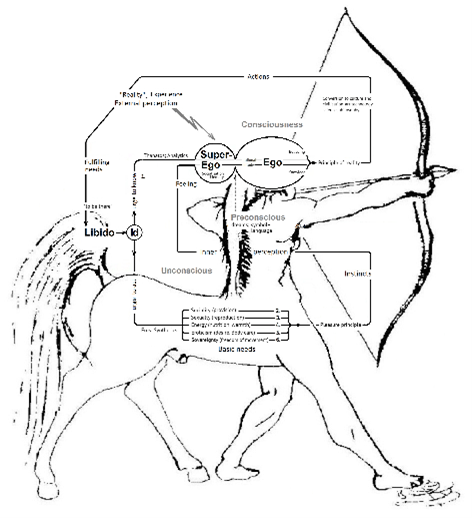
ABOVE: A rendition of the later psychic ‘topography’ as inspired by Plato’s Phaedrus. The head of the rider symbolizes the ego consciousness, associated with the reality principle. Obviously, the animal body is representative of the instinctual demands of the ‘It.’ For early and later Freud, libidinal energy maintains a dualism insofar as the mental urge to know (ego drives) clash with the bodily urge to act. We may describe the clinical goal of psychoanalysis as finding a way to mediate both instincts in the ego so as to fulfill the needs of the id. This recalls Aristotle’s notion of the human soul as containing an aspect separate from reason, but nevertheless related to it.
For more on the connections between Aristotle’s moral psychology and psychoanalysis, see:
Lear, Jonathan. Freud: An Introduction.
Ibid, “Integrating the Non-Rational Soul.”
Freud does mention ‘Hegelianism’ as well as Marxism in his New Introductory Lectures. But Freud only mentions Hegel in passing with no specific details, and discusses Marxism as an evolving historical current having boiled over in the Soviet Union. When it comes to Marx, Hegel, and the dialectic method, Freud pleads ignorance. See, New Introductory Lectures on Psychoanalysis. SE, pg. 177.
Freud, Sigmund. “Formulations on the Two Principles of Mental Functioning,’ SE, pg. 219.
“Formulations,” Ibid.
Which Freud will later theorize is the emblematic characteristic of the universal death instinct.
“Formulations,” Ibid.
Ibid.
Imago is a term coined by C.G. Jung to describe a qualitative, experiential image of a thing––a premature thing presentation–– as Freud would put it.
For Freud and the psychoanalyst Jean Laplanche, the instinctual, biological realities of hunger, thirst, rest, etcetera are ‘anaclitic.’ They ‘lean on’ the sexual instinct through the creation of phantasy. To borrow Marxist terminology, libido becomes libido whenever there is a surplus pleasure over and above what is necessary for the human to reproduce itself. This is only possible through the introduction of phantasy.
See,
Laplanche, Jean. The Temptation of Biology in Freud’s Three Essays on Sexuality
Ramos, Bradley. Freud and the Problem of Sexuality
“Formulations,” 219.
Freud, Sigmund. The Ego and the Id. RSE, pp. 21-22:
It is easy to see that the ego is that part of the id which has been modified by the direct influence of the external world through the medium of the Pcpt.-Cs.; in a sense it is an extension of the surface differentiation.
See Reich’s works:
The Mass Psychology of Fascism
“Character and Society” in Sex Pol Essays
Reich, Wilhelm. “Dialectical Materialism and Psychoanalysis,” in Sex Pol Essays. Pp. 27-30.
“Formulations,” 215.
https://www.michaelalanbecker.com/blog/freud-formulations-on-the-two-principles-of-mental-functioning-1911-vii
Consider Michael Becker’s steller description of Freud’s differences between other Western perspectives on human flourishing:
…This is quite different than the conventional picture familiar from, say, Augustine, who conceives fallen life on earth as a struggle between virtue and sin, reason and ineradicable impulse, whose outcome — short of grace — can only be suffering, failure, and loss. Freud is not merely teaching the perennial wisdom that sensuous desire, the demand for pleasure, is ultimately ineradicable in this life — a lesson that few people sincerely doubt. Beyond this, Freud is claiming that, unbeknownst to ourselves, at the very deepest layers, there is an agency unaware of any struggle at all. This agency sees no reason not to maintain all its claims to undiminished pleasure; has no knowledge of the compromises struck by the “higher” agencies with reality; no sense that its instinctual life of risk has been exchanged for a rational life of predictable security.
Freud, Sigmund. Beyond the Pleasure Principle. RSE, pg. 6.